For most of human history, time was measured by the movement of celestial bodies — the sun crossing the sky, the moon cycling through its phases, the stars wheeling overhead. Then came mechanical clocks, quartz oscillators, and atomic clocks. Each leap in timekeeping technology didn't just give us better clocks — it unlocked entirely new capabilities in science, navigation, communication, and commerce. Today, we stand on the threshold of another such leap, one that will redefine what it means to measure time.
The next generation of timekeeping technologies — optical lattice clocks, nuclear clocks, and quantum entanglement-based synchronization — promises accuracy so extreme that the very concepts of time and gravity become intertwined. Meanwhile, humanity's ambitions to become a multi-planetary species are forcing us to confront a question nobody in history has had to answer: how do you keep time on another planet? This article explores the frontiers of timekeeping, from the laboratories pushing the limits of precision to the Martian colonies that will need entirely new time systems.
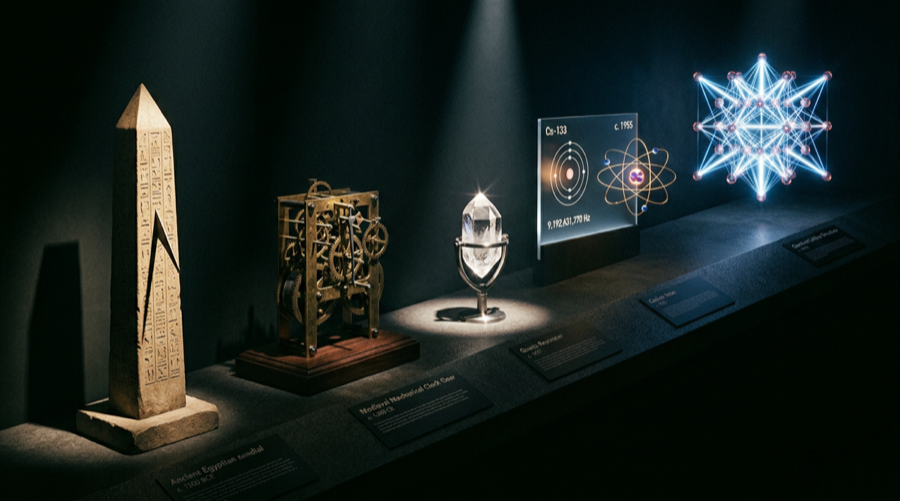
The Current Standard: Cesium Atomic Clocks
Since 1967, the international definition of one second has been based on the cesium-133 atom. Specifically, one second is defined as 9,192,631,770 oscillations of the radiation emitted during a specific transition of the cesium-133 atom. Cesium fountain clocks, the current gold standard, achieve an accuracy of about one second in 300 million years. That might sound impossibly precise, but it's actually not precise enough for many cutting-edge applications.
GPS satellites, for example, rely on atomic clocks to calculate your position. An error of just one nanosecond — one billionth of a second — translates to a position error of about 30 centimeters. Financial markets execute trades in microseconds, and even a tiny clock discrepancy between exchanges can create opportunities for arbitrage or cause regulatory problems. The international time standard, Coordinated Universal Time (UTC), is maintained by a network of approximately 450 atomic clocks around the world, weighted and averaged by the International Bureau of Weights and Measures (BIPM) in Paris.
Optical Lattice Clocks: The Next Leap
The most exciting development in timekeeping is the optical lattice clock, which uses atoms like strontium or ytterbium trapped in a lattice made of intersecting laser beams. Instead of measuring microwave transitions like cesium clocks, optical clocks measure transitions at visible light frequencies — which oscillate roughly 100,000 times faster than microwaves. More oscillations per second means finer division of time, which means dramatically higher precision.
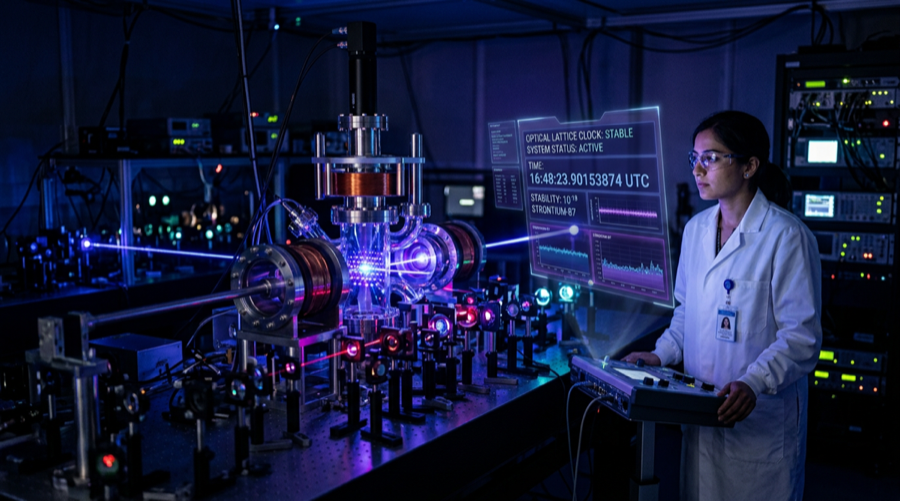
The numbers are staggering. The best optical lattice clocks demonstrated in laboratories at JILA (University of Colorado), NIST, the University of Tokyo, and the Physikalisch-Technische Bundesanstalt (PTB) in Germany have achieved accuracies of approximately one second in 15 billion years — longer than the current age of the universe. At this level of precision, a clock started at the Big Bang would still be accurate to within one second today.
This extraordinary precision has a surprising practical consequence: optical clocks are so accurate that they can detect the gravitational time dilation predicted by Einstein's general theory of relativity over height differences of just a few centimeters. A clock on a table ticks measurably faster than a clock on the floor because it's slightly farther from Earth's gravitational center. This effect, confirmed by experiments at NIST and PTB, opens up revolutionary applications in geodesy — the science of measuring Earth's shape and gravitational field.
Redefining the Second
The extraordinary performance of optical clocks has set the stage for a historic event in metrology: the redefinition of the second. The current cesium-based definition, adopted in 1967, is now the weakest link in the International System of Units (SI). The General Conference on Weights and Measures (CGPM) has signaled that a new definition based on an optical transition — likely in strontium or ytterbium — could be adopted as early as 2030. This would be the first change to the definition of the second in over 60 years, and it would make every other measurement that depends on time — including the meter, which is defined in terms of the speed of light — more precise.
Nuclear Clocks: Beyond Atomic
Even more precise than optical atomic clocks are nuclear clocks — a technology still in early development that measures transitions within the nucleus of an atom rather than its electron shell. The most promising candidate is thorium-229, which has an unusually low-energy nuclear transition that can potentially be excited by ultraviolet lasers. A nuclear clock based on thorium-229 could achieve precision 10 to 100 times greater than the best optical clocks, potentially reaching accuracies of one second in hundreds of billions of years.
In 2024, a team at JILA successfully demonstrated laser excitation of the thorium-229 nuclear transition for the first time, a breakthrough that had been pursued for over 20 years. While a practical nuclear clock is still years away, this milestone opened the door to a new era of timekeeping. Nuclear clocks would be uniquely valuable because nuclear transitions are much less sensitive to external perturbations like electric and magnetic fields, making them more stable and portable than optical clocks.
Timekeeping in Space: The Challenge of Mars Time
As humanity prepares for eventual crewed missions to Mars and the possibility of permanent settlements, the question of how to keep time on another planet becomes increasingly urgent. Mars presents several unique challenges that make Earth's time systems inadequate.
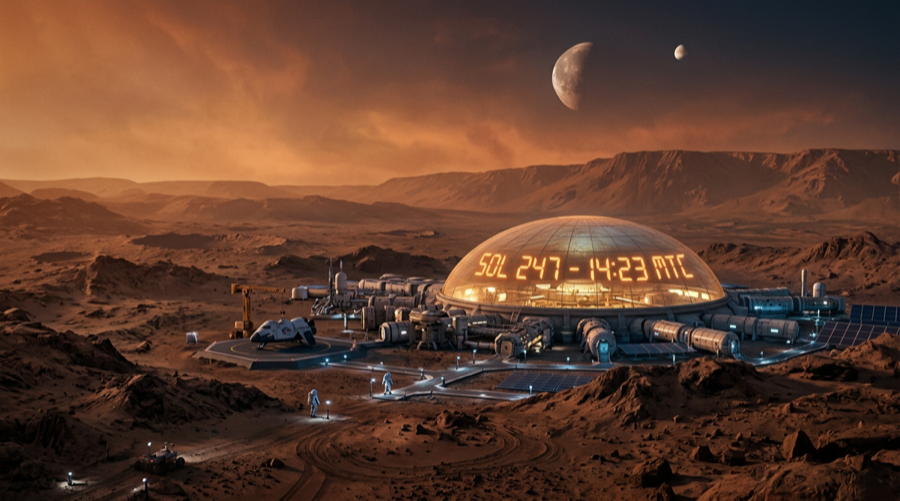
The Martian Sol
A Martian day, called a 'sol,' is approximately 24 hours, 39 minutes, and 35 seconds long — about 2.7% longer than an Earth day. This difference might seem trivial, but over weeks and months it accumulates dramatically. After just 37 sols, a Mars clock and an Earth clock would be a full day apart. NASA's Mars rover teams have experienced this firsthand: during the early Spirit and Opportunity missions, flight controllers lived on 'Mars time,' shifting their schedules 39 minutes later each day. Many reported severe fatigue, disorientation, and social isolation as their waking hours drifted completely out of sync with Earth's day-night cycle.
Proposed Mars Time Systems
Several proposals exist for a Martian time system. The simplest approach is to use a 'stretched second' — dividing each sol into 24 Martian hours, each Martian hour into 60 Martian minutes, and each Martian minute into 60 Martian seconds. A Martian second would be about 1.027 Earth seconds. This preserves the familiar 24-hour clock format but means that a 'second' on Mars is physically different from a second on Earth — a conceptual headache for scientists and engineers who need precise synchronization between the two planets.
An alternative proposal adds a 25th hour to the Martian clock — a short 'extra hour' of about 39 minutes inserted at midnight, during which the clock effectively pauses. This preserves the standard second but creates an unusual daily gap. A third approach abandons hours and minutes entirely, dividing the sol into metric units — perhaps 1,000 'millisols,' each lasting about 88 Earth seconds. None of these proposals has achieved consensus, and the eventual choice will likely depend on the practical needs of the first permanent Martian residents.
The Light-Speed Delay Problem
Beyond the sol-day mismatch, Mars time faces a deeper challenge: the speed of light. Radio signals between Earth and Mars take between 4 and 24 minutes to travel one way, depending on the planets' relative positions. This means real-time synchronization of clocks between the two planets is physically impossible — there will always be a communication delay. Mars will need its own autonomous time standard, maintained by atomic clocks on the planet's surface, with periodic corrections synchronized from Earth when signal conditions allow. The concept of a 'universal' time standard will need to become an 'interplanetary' time standard.
Quantum Entanglement and the Future of Clock Synchronization
One of the most intriguing frontiers in timekeeping research is the use of quantum entanglement to synchronize distant clocks with precision that classical methods cannot achieve. In quantum clock synchronization, entangled photon pairs are shared between two locations. The quantum correlations between these photons can, in theory, be used to synchronize clocks with precision limited only by quantum mechanics — surpassing the limitations imposed by the speed of light on classical synchronization methods.
Research groups at MIT, the Max Planck Institute, and the Chinese Academy of Sciences have demonstrated proof-of-concept quantum clock synchronization over fiber optic networks. While practical quantum-synchronized global time networks are likely decades away, the potential is revolutionary: imagine a world where every clock on Earth — and eventually on Mars, the Moon, and space stations — is synchronized to quantum precision, enabling new capabilities in navigation, communication, scientific experiments, and financial systems.
Practical Implications: Why Ultra-Precise Time Matters
Next-Generation GPS and Navigation
Current GPS provides accuracy of about one to two meters for consumer devices. With optical clock technology deployed in satellites, positioning accuracy could improve to the millimeter level. This would transform autonomous vehicles, precision agriculture, construction, surveying, and disaster response. Indoor navigation, currently a major challenge, could become reliable enough to guide a robot through a warehouse or a person through a hospital.
Gravitational Wave Detection
Ultra-precise clocks could complement gravitational wave observatories like LIGO and the future LISA space mission. By comparing the tick rates of optical clocks at different locations, scientists can detect minute distortions in spacetime caused by passing gravitational waves. This approach could open new frequency windows for gravitational wave astronomy, potentially detecting waves from sources that current detectors cannot observe.
Fundamental Physics
Clocks precise enough to detect centimeter-scale gravitational time dilation become tools for testing the fundamental laws of physics. Are the constants of nature truly constant, or do they change over time? Is Einstein's general relativity perfectly accurate at every scale? Does dark matter interact with normal matter in ways that affect atomic transitions? Ultra-precise clocks can test these questions with unprecedented sensitivity, potentially revealing new physics beyond the Standard Model.
The Philosophical Dimension: What Is Time?
As our ability to measure time improves, the philosophical question of what time actually is becomes harder to avoid. Is time a fundamental feature of the universe, or does it emerge from more basic processes? Physicist Carlo Rovelli has argued that at the quantum level, time may not exist at all — that what we experience as the passage of time is an emergent property of thermodynamics and entropy. If Rovelli is right, then our ever-more-precise clocks are measuring something that is, in some deep sense, not quite real.
Regardless of these philosophical debates, the practical impact of better timekeeping is undeniable. From the sundials of ancient Egypt to the optical lattice clocks of today, every advance in time measurement has expanded human capability. The future of timekeeping promises not just better clocks, but a deeper understanding of the universe we inhabit — and the new worlds we aspire to call home.
Frequently Asked Questions
How accurate are the most precise clocks in the world?
The most precise clocks currently in existence are optical lattice clocks, which achieve an accuracy of approximately one second in 15 billion years. This means if such a clock had been started at the Big Bang, it would still be accurate to within about one second today. These clocks are so precise that they can detect the gravitational time dilation caused by a height difference of just a few centimeters.
How long is a day on Mars?
A Martian day, called a sol, is approximately 24 hours, 39 minutes, and 35 seconds long — about 2.7% longer than an Earth day. This seemingly small difference accumulates quickly: after about 37 sols, a Mars clock and an Earth clock would differ by a full day.
Will the definition of a second change?
Yes, it is expected to change. The current definition, based on cesium-133, has been in place since 1967. The General Conference on Weights and Measures is planning to adopt a new definition based on optical transitions, likely in strontium or ytterbium atoms, potentially as early as 2030. This will be the first redefinition of the second in over 60 years.
What is a nuclear clock?
A nuclear clock measures transitions within the nucleus of an atom rather than its electron shell. The most promising candidate uses thorium-229. Nuclear clocks could be 10 to 100 times more precise than optical clocks and less sensitive to external disturbances, though practical nuclear clocks are still in early development.
How does GPS depend on atomic clocks?
GPS satellites carry atomic clocks that broadcast precise time signals. Your GPS receiver compares the arrival times of signals from multiple satellites to calculate your position. A timing error of just one nanosecond causes a position error of about 30 centimeters. Without atomic clocks, GPS would be accurate only to within several kilometers.